


Page 8 - Demo
P. 8
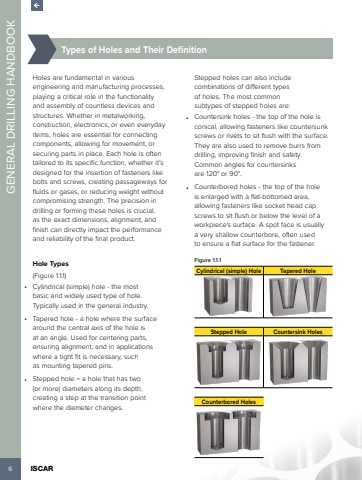
6 ISCAR GENERAL DRILLING HANDBOOK %u00bd%u0009Types of Holes and Their DefinitionHoles are fundamental in various engineering and manufacturing processes, playing a critical role in the functionality and assembly of countless devices and structures. Whether in metalworking, construction, electronics, or even everyday items, holes are essential for connecting components, allowing for movement, or securing parts in place. Each hole is often tailored to its specific function, whether it%u2019s designed for the insertion of fasteners like bolts and screws, creating passageways for fluids or gases, or reducing weight without compromising strength. The precision in drilling or forming these holes is crucial, as the exact dimensions, alignment, and finish can directly impact the performance and reliability of the final product.Hole Types(Figure 1.1.1)%u2022 Cylindrical (simple) hole - the most basic and widely used type of hole. Typically used in the general industry. %u2022 Tapered hole - a hole where the surface around the central axis of the hole is at an angle. Used for centering parts, ensuring alignment, and in applications where a tight fit is necessary, such as mounting tapered pins. %u2022 Stepped hole %u2013 a hole that has two (or more) diameters along its depth, creating a step at the transition point where the diameter changes. Stepped holes can also include combinations of different types of holes. The most common subtypes of stepped holes are:%u2022 Countersink holes - the top of the hole is conical, allowing fasteners like countersunk screws or rivets to sit flush with the surface. They are also used to remove burrs from drilling, improving finish and safety. Common angles for countersinks are 120%u00b0 or 90%u00b0.%u2022 Counterbored holes - the top of the hole is enlarged with a flat-bottomed area, allowing fasteners like socket head cap screws to sit flush or below the level of a workpiece's surface. A spot face is usually a very shallow counterbore, often used to ensure a flat surface for the fastener.Figure 1.1.1Cylindrical (simple) Hole Tapered HoleStepped Hole Countersink HolesCounterbored Holes


